Wednesday, September 22, 2010

World Animal Day highlights endangered species

Less than two weeks away, Oct. 4 stands out as World Animal Day, an opportunity to focus attention on endangered species while celebrating animals' roles in human lives. The celebration began in 1931 during a convention of ecologists in Italy and expanded its focus in recent years.

The current mission statement says the day provides a way:
* To celebrate animal life in all its forms
* To celebrate humankind’s relationship with the animal kingdom
* To acknowledge the diverse roles that animals play in our lives – from being our companions, supporting and helping us, to bringing a sense of wonder into our lives
* To acknowledge and be thankful for the way in which animals enrich our lives

By clicking on a region in this map, you can find events near you. Want to organize an event that focuses on wild birds? Click here for tips and guidelines.

Labels: ,

Thursday, September 09, 2010

Scouts are Flying Wild

A program aimed at schoolchildren and created by Council for Environmental Education, Flying Wild partners recently worked with Boy Scouts of America and Girl Scouts of the United States of America to integrate the environmental education activities with current scout badges and Try-It Activities.

This document shows the correlations between Flying Wild items and the Girl Scout projects for Brownies and Juniors, while this file covers the Boy Scout projects, ranging from Cub Scouts, Tigers, Wolfs, Bears and Webelos to Boy Scouts.

Labels: , ,

Thursday, August 19, 2010

When we guard birds, do we harm birding?

A good essay about the next great birders recently made the rounds via Facebook and other sites. Laura Kammermeier's blog post touched on the challenges that many beginning birders might encounter, including this part:
Beginners soon sense what really goes on in birding circles: the catty judgment about who knows what more than who. Some segments of birding operate like an exclusive country club where the cost of entry is not piles of cash, but loads of birding cachet. But whom does that leave behind — and what is the cost?

Regrettably, we’ve all seen the enthusiasm of novice birders stamped out by the corrective whoop-di-doo of birding hotshots. We’ve seen dialogue on listserves squelched by those who assert that feeder sightings, backyard raptor kills, and birding trivia has “no place on this list.” We’ve seen legions of birders too afraid to ask questions for fear of being wrong, stupid, clearly “not a REAL birder.”

That resonated with me, given the magazine's focus on expanding the community. In each issue, on page 2, you'll see WildBird's mission statement, which says "WildBird urges readers to share their appreciation for birds and to consider beginners' education... as means of ensuring avian species' survival."

In one discussion of Laura's blog post, a New Jersey birder mentioned a recent Long-eared Owl roost at which some birders stood guard all day, pretending to watch something in the field across the street. My friend (whom I'll call DL) said the sentry birders told him that's what they were actually doing -- trying to misdirect others.

Like DL said, owls are sensitive and need to be protected, but why would the birders want to keep the roost's location secret from naturalists who might become more interested in avian conservation or birders who've long wanted to see LEOWs? That seems counterproductive to building support for bird conservation. To quote DL: "That really left a sour taste in my mouth."

Do you know birders who've guarded a species' site? What did you think of their decision?

Long-eared Owl courtesy of Terry Sohl

Labels: , ,

Wednesday, April 28, 2010

More funds for 'More Kids in the Woods'

Yesterday, Agriculture Secretary Tom Vilsack said USDA's Forest Service will contribute $500,000 this year to the "More Kids in the Woods" program for projects that promote outdoor activities.

"If we are going to put an end to childhood obesity, we must promote healthy, active lifestyles and encourage our kids to get off the couch and go outside," said Vilsack. "Our 'More Kids in the Woods' challenge not only promotes physical activity, it fosters environmental awareness and stewardship among young people as we face critical environmental challenges, such as the effects of climate change. 'More Kids in the Woods' helps kids make the connection between healthy forests, healthy communities and their own healthy lifestyles."
The contribution will join $1.5 million in donations and in-kind services from partners. The Forest Service selected 21 projects for funding from more than 130 proposals. All projects focus on curating curiosity about nature and the role of forests and grasslands in providing clean water, clean air and wildlife habitat.

Among the 21 projects, one deals specifically with birds. Kids Take Flight Educational Program at White River National Forest & Rocky Mountain Bird Observatory in Glenwood Springs, Colo., will provide 500 children, ages 6 to 12, with hands-on experiences like releasing rosy-finches, experiencing dragonfly metamorphosis and investigating owls.

Labels: ,

Wednesday, March 31, 2010

NestWatch needs your eyes

Cornell Lab of Ornithology's NestWatch seeks citizen scientists for its annual nest-monitoring program. Anyone who finds an active nest can participate by logging in or creating an account on the NestWatch site, becoming certified online, making notes about the birds' nesting activities and sharing the data via the "My Nests" page. The site includes gobs of information, such as downloads that cover a code of conduct, a project manual and quick guides to "focal species" as well as tips about helping nesting birds and details about the protocol for monitoring nests.

Why should someone spend time checking a nest every four days and entering data online? “Collecting this information across the continent over long periods of time is one of the best ways we have to detect widespread changes in bird breeding biology,” says Laura Burkholder, NestWatch project leader.

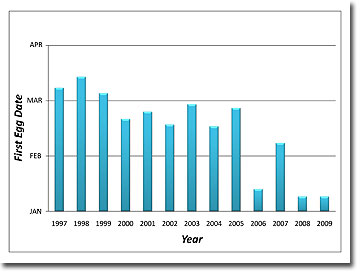
For instance, NestWatch data from 1997 to 2009 shows that Eastern Bluebirds might be laying their first eggs sooner (above). More long-term data from citizen-science projects like NestWatch can clarify the effects of environmental change and human land use on breeding birds.

Labels: ,

Tuesday, March 30, 2010

"Mission: Migration" online game

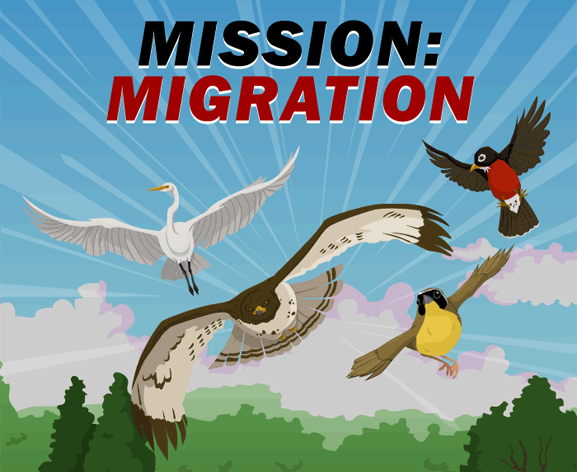
Want to help your flock safely fly long distances while looking for food, water, shelter and space? Click on Mission: Migration to accept the challenge and see how birds travel during spring and fall migrations.

Players will help the flock dodge storms and airplanes, catch jet streams and fly faster or slower. They also will choose landing sites when the flock runs out of energy.

Kudos to the designers for choosing to feature a young woman as the birder who introduces the animated game! Unfortunately, the pop-up screen wasn't adjustable in size, the text appeared in a small font, and the symbols in the farmland landing zone were too small to read as hazards; the game could be better but illustrates some great concepts.

Labels: , ,

Sunday, March 28, 2010

6 cities join Flying WILD bird program for children

Communities in the East recently began participating in Flying WILD, a program from the Council for Environmental Education. The new partners include Bowling Green, Ky. (Western Kentucky University's Center for Environmental Education and Sustainability); Fort Wayne, Ind. (Science Central); Glen Rose, Texas (Fossil Rim Wildlife Center); Murfeesboro, Tenn. (Discovery Center at Murfee Spring); Newark, N.J. (Newark Museum); and Point Pleasant Beach, N.J. (Jenkinson's Aquarium).

Flying WILD focuses on three goals: using birds to teach core curriculum, providing teachers with educational tools and partnerships, and expanding International Migratory Bird Day celebrations. This year, IMBD falls on May 8; it typically occurs on the second Saturday of May.

Flying WILD's city partners include 27 other communities around the United States and in Canada. You can look for a local event here.

Labels: ,

Friday, September 18, 2009

Sibley to lecture in Madison, N.J., on Sept. 22

At Drew University on Tuesday, David Allen Sibley -- author of the new "The Sibley Guide to Trees" will lecture on "The Art of Identification" at 7 p.m. in the Dorothy Young Center for the Arts Concert Hall. After speaking, Sibley will take questions and sign books.

From DailyRecord.com:

"Art has always been about understanding things," says Sibley, a resident of Concord, Mass. "Drawing forces me to look at things closely. I have to look at every part of it. If art has taught me anything, it's how important drawing is to understanding what things look like and how they fit into the bigger scheme of things."

Labels:

Monday, April 20, 2009

New raptor center, wetlands center open in Kansas

Barton County, Kan., now offers two sites likely to attract more birders: Kansas Raptor Center at Great Bend Zoo and Kansas Wetlands Education Center.

Zoo Director Mike Cargill said injured raptors that come to the center go through a step-by-step process. They are rehabilitated in the center's intensive care unit and then go to a critical care unit outside on the zoo grounds.

After that, they will learn to fly while being carefully observed by inmates from the Larned Correctional Facility. The birds will be sent to "large fly pens" at the correctional facility, and inmates will track and record the raptors' movements, Cargill said.

He said being able to use the inmates works well for the project because they can sit and observe the birds for hours at a time.
Operated by Fort Hays State University, the wetlands center will open officially on April 24. It overlooks Cheyenne Bottoms, "the largest inland marsh in the United States and a Ramsar-designated Wetland of International Importance."


View Larger Map

Labels: , , ,

Wednesday, October 22, 2008

Bird Education Network conference in February

Bird Education Network, Council for Environmental Education and Flying WILD plan to host a national conference on Feb. 22-26 at Jekyll Island Club Hotel on Jekyll Island, Ga. The event will focus on "bird conservation through education," and the downloadable registration packet is here. Early registrants pay $295 before Dec. 15; later registrants pay $350.


View Larger Map

From the BEN website:

The conference is open to anyone with an interest in bird education and conservation efforts, including directors, administrators, and educators from federal, state, and local government agencies, conservation organizations, zoos/aquariums, bird-related businesses, universities, K-12 schools, nature centers, Audubon centers, bird clubs, other NGOs, and related non-profit groups.

Guest Speakers: Throughout the conference there will be a diverse group of guest speakers, including Kenn and Kim Kaufman ("Working Toward a Bird Literate Society"), Audrey Peterman ( "Creating Dynamic Relationships with Diverse Audiences"), David Waller ("Lessons to Share on Bird Conservation, Wildlife Education Funding, and Building Coalitions"), and Donald and Lillian Stokes ("Reaching and Motivating the Public with Important Bird Messages").

Labels: ,

Wednesday, August 20, 2008

News from the bird banding scholarship in Washington

This comment recently appeared on the July 31 post about the Puget Sound Bird Observatory banding scholarship:

Our scholarship recipient, Tayler Brooks, is having an incredible experience. Some of the group's banding highlights include an American Three-toed Woodpecker, a Wilson's Snipe, and a White-winged Crossbill. Take a look at our banding camp blog for field notes.

Emily Sprong
Puget Sound Bird Observatory
www.pugetsoundbirds.org

Labels: ,

Thursday, July 31, 2008

Puget Sound Bird Observatory banding scholarship

From a post to the Young Birder Yahoo!group:

Puget Sound Bird Observatory Banding Scholarship

- Are you under 26 (or thereabouts)?
- Are you interested in working with wildlife as a career?
- Are you looking for a way to develop valuable skills without breaking the bank?

Puget Sound Bird Observatory is offering a $350 scholarship for our Cascades Banding Camp (that covers 50% of the cost). Learn how to band birds Aug. 16-23 in Washington's Cascade Mountains with expert banders and trainers. This seven-day camping trip will feature riparian and mountain birding and banding at several locations with opportunities to see and possibly handle great Northwest birds like Williamson's Sapsucker, Hammond's Flycatcher, and MacGillivray's Warbler.


View Larger Map

Class fee for scholarship recipient: $350 (includes PSBO membership and book fee).

Go to the Puget Sound Bird Observatory website for more info about the camp and to download a scholarship application. E-mail Emily AT pugetsoundbirds DOT org if you have questions.

This scholarship is made possible by a generous grant from the Point
Defiance chapter of American Association of Zoo Keepers.

Emily Sprong
Puget Sound Bird Observatory
Sound Science - Scientific Information - Informed Public
Puget Sound Bird Observatory studies birds and their habitats in the
Pacific Northwest to better understand changes in bird populations, to
inform decision-makers, and to engage the public with birds and their
needs.

Labels: ,

Tuesday, June 17, 2008

Plastinated ostrich on display

Are you familiar with "Body Worlds" and "Bodies... The Exhibition"? The companies prepare cadavers for public viewing, turning the bodies into incredibly educational displays by removing all water and fatty tissue and replacing them with polymers. I viewed the latter in Las Vegas and felt enthralled by the exhibition, which included a lot of information (with a touch of humor) with the dissected bodies and colored organs.

The creator of Body Worlds, Dr. Gunther von Hagens, recently unveiled an ostrich plastinate (and a giraffe plastinate) in "The Story of the Heart" exhibition at the California Science Center. Seen before only in Germany, the ostrich plastinate shows how that species' cardiovascular system differs and mirrors the human cardio system.

Body Worlds 3 -- with the ostrich specimen -- will remain at the California Science Center in Los Angeles until early September.

Labels:

Sunday, November 25, 2007

Kudos to bird-aware teachers!

From The Daily News in McKeesport, Pa.:

Consortium for Public Education Rewards 'Great Ideas'

Those funds were applied to Steel Valley's "Math and Science: It's for the Birds"; South Allegheny's "Birds Count"; and the Finley Middle School Composting Project in Ringgold School District.

To Steel Valley Middle School, $1,350 was given for 170 sixth-graders to study the local bird population, taking pictures, doing research on various species and studying their biology.

In math classes, students will learn about various styles of birdhouses and calculate their surface areas, volumes and openings.

They then will build birdhouses specific to certain species and study the birds that use them. The houses will be placed in the memorial garden, the educational pond area and the outdoor classroom.

Dominion gave $1,054.65 to "Birds Count," in which 585 students at South Allegheny Elementary will participate in birding activities.

After bird behavior and identification lessons are taught in the classroom, students will participate in monthly birding events, collecting and submitting data to the online PA Bird Atlas, E-Bird and Urban [Bird] Studies.

Students will share their observations via a school bulletin board and school television network.

Teachers Audrey Aubrecht, Patricia Kostik and Karen Kadar applied for the grant.

Labels: ,

Saturday, November 24, 2007

Bird Education Network

Do you consider yourself a bird educator? Did you attend the Bird Conservation through Education gathering in Austin, Texas, last February?

Would you like to trade ideas and develop strategies with other bird educators? Subscribe to the BirdEd listserv by sending an e-mail to birdedlist-subscribe AT flyingwild DOT org. In the e-mail, state your name, organization, title, mailing address, phone and fax numbers and website.

Labels: ,