Thursday, February 10, 2011

Great Backyard Bird Count in the news

The annual Presidents Day weekend census of backyard birds will start on Friday, Feb. 18, but it's already in the news from Maine to Arizona. The Great Backyard Bird Count -- organized by The Cornell Lab of Ornithology, National Audubon Society and Bird Studies Canada -- gives casual and expert birdwatchers alike the chance to contribute data and create a snapshot of winter bird populations in two nations.

All the details appear at Great Backyard Bird Count, including a PDF of instructions, a video that describes the available prizes -- Yes! There are prizes! -- and the photo galleries generated by the GBBC photo contest.

2010 Overall Winner: American Robin by Nick Saunders, courtesy of GBBC

Labels: , ,

Tuesday, July 27, 2010

More winged things to count

Do you live where fireflies light up your sky? If so, I'm jealous of you. (Southern California lacks lightning bugs.)

If you are fortunate enough to see those beetles with tails that flash, you can contribute to Firefly Watch, organized by Museum of Science Boston. The museum is working with researchers from Tufts University and Fitchburg State College to track fireflies, but they need citizen scientists to help them learn about the beetles' geographic distribution and activity during summer. The museum's website says fireflies might be affected by human-made light and pesticides in lawns, so the data can investigate those effects.

This is the event's third year. It began in mid-April and will continue through October. You can join the citizen science project now!

Photo courtesy of Nature

Labels: ,

Tuesday, April 20, 2010

Biscayne BioBlitz

Will you be near Miami, Fla., on April 30 or May 1? Do you want to become a citizen scientist for a day? Then help National Geographic and the National Park Service conduct a comprehensive survey of all the life within Biscayne National Park.

The NatGeo site says:

A BioBlitz is a 24-hour event in which teams of volunteer scientists, families, students, teachers, and other community members work together to find and identify as many species of plants, animals, microbes, fungi, and other organisms as possible. A BioBlitz gives adults, kids, and teens the opportunity to join biologists in the field and participate in bona fide research expeditions. It's a fun and exciting way to learn about the biological diversity of local parks and to better understand how to protect them.
Close to 95 percent of this national park is underwater, so participants can register beforehand to reserve space on a ferry or snorkel boat.


All the details about the BioBlitz appear here, including the FAQ, the registration form for the ferry or snorkel boat (very limited seats!) and educational resources for grades 3-5 and adults.

Labels: ,

Wednesday, March 31, 2010

NestWatch needs your eyes

Cornell Lab of Ornithology's NestWatch seeks citizen scientists for its annual nest-monitoring program. Anyone who finds an active nest can participate by logging in or creating an account on the NestWatch site, becoming certified online, making notes about the birds' nesting activities and sharing the data via the "My Nests" page. The site includes gobs of information, such as downloads that cover a code of conduct, a project manual and quick guides to "focal species" as well as tips about helping nesting birds and details about the protocol for monitoring nests.

Why should someone spend time checking a nest every four days and entering data online? “Collecting this information across the continent over long periods of time is one of the best ways we have to detect widespread changes in bird breeding biology,” says Laura Burkholder, NestWatch project leader.

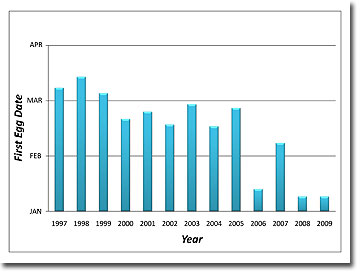
For instance, NestWatch data from 1997 to 2009 shows that Eastern Bluebirds might be laying their first eggs sooner (above). More long-term data from citizen-science projects like NestWatch can clarify the effects of environmental change and human land use on breeding birds.

Labels: ,

Tuesday, February 02, 2010

Cornell wants to give you money

The Celebrate Urban Birds project at Cornell Lab of Ornithology seeks applications for mini-grants of $250 to $500. Eligible recipients include museums, afterschool programs, libraries, community centers and local organizations that want to create neighborhood events involving art, gardening, science, community service or other cultural activities.


The call for applications says:
If you are planning an event, you're invited to apply for a grant at www.CelebrateUrbanBirds.org. Organizations working with underserved communities are strongly encouraged to apply. No experience with birds is required.
Further details on the website reveal that qualified applicants should plan to:
* participate in a training videoconference
* hold a Celebrate Urban Birds event in 2010
* introduce the public/youth to birds
* collect Celebrate Urban Birds data and inspire others to observe birds and collect data
* distribute Celebrate Urban Birds kits (with posters, seeds for planting, and more)
* integrate the arts
* integrate gardening/habitat creation
* get people outside
* submit a short final report and share pictures with photo releases.

The application deadline is Monday, Feb. 15. Winners will be announced on March 1.

Labels: ,

Thursday, January 28, 2010

Great Backyard Bird Count, Feb. 12-15

Show your love for birds during Valentine's Day weekend by participating in the Great Backyard Bird Count! The citizen-science project involves as little as 15 minutes on one day or as many minutes as you like on Feb. 12th through 15th.


Organized by Cornell Lab of Ornithology, National Audubon Society and Bird Studies Canada, the 13th annual free event entails counting birds in your back yard or at local parks or refuges. Then you just fill in an online checklist of observed species and their numbers.

Why would you do this?
Scientists and bird enthusiasts can learn a lot by knowing where the birds are. Bird populations are dynamic; they are constantly in flux. No single scientist or team of scientists could hope to document the complex distribution and movements of so many species in such a short time.

We need your help. Make sure the birds from your community are well represented in the count. It doesn't matter whether you report the 5 species coming to your backyard feeder or the 75 species you see during a day's outing to a wildlife refuge.
If you take pictures of the birds during the Great Backyard Bird Count, consider entering them in the photo contest. You might win one of many prizes!

Eastern Bluebird courtesy of Katya Porter in North Carolina, a winner in the 2009 photo contest

Labels: , , ,

Friday, October 09, 2009

Not too late to join Project FeederWatch!

Want to share your backyard birds with a nationwide project? Then Cornell Lab of Ornithology wants to hear from you!

Project FeederWatch runs from November through April, and during those months, backyard birders count and report the birds visiting their feeders. The citizen science project provides training and materials, so new birders can join the fun, too.

Many details appear here, including the $15 participation fee that covers the research kit provided via snail mail or online. Register today so you can receive the kit as quickly as possible!

Labels: ,

Tuesday, March 24, 2009

Bird Phenology Program seeks birders to transcribe data

The U.S. Geological Survey needs birders to help with historical notecards of bird observations dating back 100 years. Do you want to peek into your favorite species' history?

As part of the USGS North American Bird Phenology Program, birders can add data from more than 6 million cards to a national database and provide "an unprecedented amount of information describing bird distributions, migration timing, and migration pathways and how they are changing," said Jessica Zelt, coordinator of the North American Bird Phenology Program at the USGS Patuxent Wildlife Research Center.


The millions of hand-scribbled cards sit in row upon row of federal green filing cabinets of ancient vintage in a modest and fittingly old office dating from before WWII. The cards contain almost all of what was known of bird distribution and natural history from the Second World War back to the later part of the 19th century, said USGS senior scientist Chan Robbins, who kept track of the cards' whereabouts in attics and basements during the intervening years.

"When I go through the files, it is just amazing some of the stories that are recorded there," said Jessica Zelt, who is an avid birder herself. "For example, one of our online participants recently wrote to tell me she had transcribed a migration card on purple martins by American ornithologist Margaret Morse Nice from 1926. It is exciting to see people today being linked to a piece of birding history."

Participants recorded their name, locality and year, along with arrival and departure dates, date of abundance, and whether it was a species common in that area. Personal observations on the cards often caught the enthusiastic joy of a birder sighting a rare bird.

The collection, said Zelt, includes information on about 900 species, including some sightings of rare, extinct, or nearly extinct birds, such as the giant albatross, ivory-billed woodpecker and Carolina parakeet [right], birds whose very names make the hearts of avid birders go pitter-patter.
You can participate in history by volunteering your time, and you needn't live near the NABPP office in the Baltimore-Washington area. Become a participant here.

Labels: ,

Monday, December 22, 2008

Christmas Bird Count 5

This time of year, birders get to see their hobby/sport/lifestyle in mainstream media, thanks to coverage of the Christmas Bird Count. The 109th count began Sunday, Dec. 14, and will continue to Monday, Jan. 5, 2009.

According to National Audubon Society's CBC FAQs page, thousands of volunteers in the Western Hemisphere dedicate 24 hours to identifying species and counting birds within a 15-mile count circle. The predetermined circles are covered by birders who report to a count compiler before the circle's count date and pay the $5 participation fee.

Recent media coverage of completed counts
MaineToday.com, Unity, Me.:
The Unity Christmas bird count occurred last Monday with mostly cloudy skies, an inch of old snow, blustery wind, and temperatures warming from 4 degrees at midnight to a gentle rain after dark.

Although all the tallies are not yet final, the preliminary numbers indicate 25 birders reported 48 species.
Cape Cod Times, Cape Cod, Mass.:
The days at the end of the year — filled with the holiday rush of shopping, parties of all sorts and family commitments — offer scant opportunities to get afield and look for birds.
Yellow-breasted Chat courtesy of E. Vernon Laux/Cape Cod Times


Press of Atlantic City, Atlantic City, N.J.:
Off in the distance, with the Atlantic City skyline piercing through a cloudy midafternoon sky, the focus is out at sea, where hundreds of birds have gathered.
Bucks County Courier Times, Levittown, Pa.:
Trudging along the trails of Silver Lake Nature Center Saturday on the annual Christmas bird count, the center's director-naturalist Bob Mercer didn't necessarily need his eyes to do the job.

Valley News Dispatch, Pittsburgh, Pa.:
Pausing along a path in Todd Nature Reserve in Buffalo Township, something caught George Reese's eye in a stand of hemlock trees.

"There's a grouse," Reese said above the low roar of nearby Hesselgesser's Run.
The London Free Press, London, Ontario, Canada:
About 150 nature enthusiasts braved temperatures around -11 C yesterday to count thousands of birds in the London area.

Citizen scientists spotted more than 60 species within a 12-kilometre radius of Reservoir Park on Commissioners Road during the 100th annual Christmas bird count, said Pete Read.
The Expositor, Brantford, Ontario, Canada:
A bright pink pillar of light rose in the eastern sky Dec. 14 and allowed itself to be spread out in layers of rose and gold by the southwest wind. It was a good beginning for the annual Woodhouse Township Christmas Bird Count. Last year, Betty Chanyi and I woke to drifting, blowing snow... and chickened out. It's one of the few times either of us has missed the count.
Dalton Daily Citizen, Dalton, Ga.:
While most teenage boys were out chasing girls, Sandy Pangle spent his high school days chasing birds.

“To a lot of people, a bird is a bird,” Pangle said. “And it became kind of a challenge to go to an area and realize there is really nothing to the untrained eye, then all this stuff started appearing.”
Photo courtesy of Dalton Daily Citizen


The Telegraph, Macon, Ga.:
Bird-lovers in Middle Georgia made their way outdoors Saturday for the annual Christmas Bird Count, a nation wide “citizen-science” effort sponsored by the National Audubon Society. In Macon, some 30 people took part this year in the more than 100-year-old tradition that seeks to annually catalog the number of birds and bird species in a given area, said Marie Amerson, with the Ocmulgee Audubon Society. This year set a local record for participation in the event, Amerson said, even though they did not find quite as many birds as in previous years.
The Oklahoman, Oklahoma City, Okla.:
Cold and windy weather didn’t keep nature lovers away from the Christmas Bird Count on Saturday at Martin Park Nature Center in Oklahoma City.

Volunteers and friends came bundled up and carrying binoculars to participate in the annual winter songbird census.
The Ukiah Daily Journal, Ukiah, Calif.:
Area bird watchers gathered at Granite Construction's Talmage operation about 7:15 a.m. Saturday to count birds as part of a yearly Christmas bird count.

Cold temperatures frosted Ukiah Valley's floor, but wearing gloves and warm clothing local Audubon chapter members focused on counting birds.
Queen Charlotte Islands Observer, Queen Charlotte Islands, British Columbia, Canada:
The screaming northeaster almost stopped our breath as we headed into it on our way to Little Spit Point at Sandspit. There was no shelter, neither for us nor for the birds. The wind chill brought the temperature down to minus 22c and it was no place for the faint-hearted.

Labels: , , ,

Saturday, December 20, 2008

Christmas Bird Count 4

This time of year, birders get to see their hobby/sport/lifestyle in mainstream media, thanks to coverage of the Christmas Bird Count. The 109th count began Sunday, Dec. 14, and will continue to Monday, Jan. 5, 2009.

According to National Audubon Society's CBC FAQs page, thousands of volunteers in the Western Hemisphere dedicate 24 hours to identifying species and counting birds within a 15-mile count circle. The predetermined circles are covered by birders who report to a count compiler before the circle's count date and pay the $5 participation fee.

Recent media coverage of completed counts
Hilton Head Island Packet, Hilton Head, S.C.:
Shrinking wildlife habitat means Audubon Society birders are counting fewer birds on Hilton Head Island than they have in the past, a trend reflected all over the world.

While the number of local species has hovered around 150 since the 1970s, the total number of birds has continually declined, said Barry Lowes of the Hilton Head Audubon Society. The local group completed its annual Christmas Bird Count last week.
Northumberland Today, Northumberland, Ontario, Canada:
On a gloomy day that seemed to be twilight throughout the daylight hours, 31 observers took to the field on Dec. 14 for the Presqu'ile-Brighton Christmas Bird Count. In total, 22,726 birds of 76 species were found during the day.
The Plain Dealer, Cleveland, Ohio:
A bevy of birds and waves of nasty weather kicked off the opening week of Christmas Bird Counts in Northeast Ohio.

With so many birders in the field, good sightings could be expected, even with the predictable rainy, gray and frigid conditions of mid-December.

Labels: , , ,

Wednesday, December 17, 2008

Christmas Bird Count 3

This time of year, birders get to see their hobby/sport/lifestyle in mainstream media, thanks to coverage of the Christmas Bird Count. The 109th count began Sunday, Dec. 14, and will continue to Monday, Jan. 5, 2009.

According to National Audubon Society's CBC FAQs page, thousands of volunteers in the Western Hemisphere dedicate 24 hours to identifying species and counting birds within a 15-mile count circle. The predetermined circles are covered by birders who report to a count compiler before the circle's count date and pay the $5 participation fee.

Recent media coverage of completed counts
Burlington Free Press, Burlingon, Vt.:
Two sleek ducks, streaks of black and white, flew in across the Winooski River from Burlington, riding the south wind and the smell of doughnuts frying at the Koffee Kup bakery.
Gloucester Daily Times, Gloucester, Mass.:
The 40 experienced bird watchers who spent Sunday recording virtually anything that flew as part of the 79th annual Cape Ann Christmas Bird Count, logged 47,000 birds in 123 species — including some interesting finds.
Bay City Tribune, Bay City, Texas:
Over 100 birders braved the cold, windy weather Monday to count 234 species of birds in the 16th Annual Matagorda County Mad Island Marsh Christmas Bird Count.
Pique Newsmagazine, Whistler, British Columbia, Canada:
Participants in the annual Whistler Christmas Bird Count have seen some tough conditions over the past 19 years, but this year’s Christmas count on Monday, Dec. 15 ranks as one of the toughest, with freezing temperatures and high winds sending birds into hiding.
Prince George Citizen, Prince George, British Columbia, Canada:
Cold weather was likely the factor that reduced the number of species naturalists observed during this week's 41st annual Prince George Christmas Bird Count.

Labels: , ,

Monday, December 15, 2008

Christmas Bird Count 1

This time of year, birders get to see their hobby/sport/lifestyle in mainstream media, thanks to coverage of the Christmas Bird Count. The 109th count began Sunday, Dec. 14, and will continue to Monday, Jan. 5, 2009.

According to National Audubon Society's CBC FAQs page, thousands of volunteers in the Western Hemisphere dedicate 24 hours to identifying species and counting birds within a 15-mile count circle. The predetermined circles are covered by birders who report to a count compiler before the circle's count date and pay the $5 participation fee.

The data collected by the birders helps researchers, biologists and other individuals study bird species' long-term health. Researchers can combine the CBC data with Breeding Bird Survey data to better understand species' behavior, and the data can generate reports, such as Common Birds in Decline and Watchlist 2007.

Today's media coverage of completed counts: San Francisco Chronicle with a nine-image photo gallery from Yosemite Valley


WFMD TV, Mansfield, Ohio
Newsday, New York, N.Y.
The Epoch Times, New York, N.Y.
Lawrence Journal-World, Perry, Kan.
The Sacramento Bee, Sacramento, Calif.
San Antonio Express-News, San Antonio, Texas

Labels: , , ,

Tuesday, March 25, 2008

Great Backyard Bird Count results

Between Feb. 15 and 18, birders submitted more than 85,700 checklists, identified 635 species and provided thousands of bird photos. The citizen scientists contributed to a database that ornithologists and other researchers can use to study species populations and distribution.

For instance, counters' checklists indicate that
* northern finches, such as Pine Grosbeak (above), came south from northern Canada to find food
* Yellow-billed Magpie populations are decreasing
* Eurasian Collard-Doves continue to adapt and spread, now reaching Oregon and the Canadian provinces of British Columbia and Manitoba

The top 10 most reported species:
1. Northern Cardinal
2. Mourning Dove
3. Dark-eyed Junco
4. Downy Woodpecker
5. American Goldfinch
6. Blue Jay
7. House Finch
8. Tufted Titmouse
9. Black-capped Chickadee
10. American Crow

For more details about the 2008 count, visit the highlights page on the Cornell Lab of Ornithology site. The lab and National Audubon Society organize the annual event, which will happen again Feb. 13-16, 2009.

Photo courtesy of U.S. Fish & Wildlife Service

Labels:

Tuesday, February 12, 2008

Great Backyard Bird Count

For four days, Cornell Lab of Ornithology wants North American residents to watch their backyard birdfeeders, count the visitors and submit data online. The Great Backyard Bird Count will start this Fridya, Feb. 15, and last through Monday the 18th.

No doubt you've heard of it before. Even the mainstream media provides coverage, if only a verbatim rerun of Cornell's press releases about the event.

Baker City Herald, Ore.
Ventura County Star, Calif.
Joplin Independent, Mo.
Chesteron Tribune, Ind.
The Post and Courier, S.C.
PressRepublican.com, N.Y.

Have you seen local coverage and/or contacted nearby media outlets to suggest GBBC as a topic?

Students at McKinley Elementary School in Elkins Park, Pa., participated in the 2007 count. Photo courtesy of Jennifer Sherwood/Cornell

Labels: ,

Friday, December 14, 2007

108th Christmas Bird Count


The counting has officially begun! National Audubon Society's annual Christmas Bird Count will run from today through Jan. 5, 2008. To find a count circle near you, click here.

From National Audubon Society:
Welcome to the Audubon Christmas Bird Count, the oldest and largest citizen science event in the world. For over a hundred years, people have gathered together during the winter holiday season to count birds. For many people, this is an annual tradition that has passed from one generation to the next. In the process, they have created a vast pool of bird data that is the most comprehensive available for mid-December to early January. It is a fertile source of information on the status and distribution of early winter bird populations and is studied by scientists and interested people the world over. And it all starts with you!

While there is a specific methodology to the CBC and you need to count birds within an existing Christmas Bird Count circle, everyone can participate! If you are a beginning birder, you will be able to join a group that includes at least one experienced birdwatcher. If your home is within the boundaries of a Christmas Bird Count circle, then you can stay home and report the birds that visit your feeder or join a group of birdwatchers in the field. If you have never been on a CBC before and you want to participate in a count this year, including feeder counting, please contact your count compiler prior to the count and prior to signing up for the count here.
Do you participate in a count? What's the best thing about it?

Labels: ,

Thursday, October 18, 2007

Project FeederWatch on Martha Stewart

Birds are a good thing.

Project FeederWatch's David Bonter recently appeared on The Martha Stewart Show. A video clip doesn't appear to be available yet, but MarthaStewart.com posted two articles: Project FeederWatch with David Bonter and Types of Bird Feed with David Bonter.

Congratulations to Cornell Lab of Ornithology on the project's 21st year and on the widespread publicity garnered on Stewart's show!

Labels:

Wednesday, April 18, 2007

National Wildlife Week: April 21-29

During National Wildlife Week, the National Wildlife Federation encourages Americans to become citizen naturalists and participate in Wildlife Watch.

Wildlife observation will help people connect with nature during this year’s National Wildlife Week observance, April 21-29. Participants in the National Wildlife Watch will download a list of wildlife and natural phenomena to observe in their backyards, neighborhoods, communities and other special places. Observers also will be challenged to watch for designated endangered species in their locale. They will then report back by posting all their findings.
It also touts Cornell Lab of Ornithology's Great Backyard Bird Count, which took place in February.

Labels: